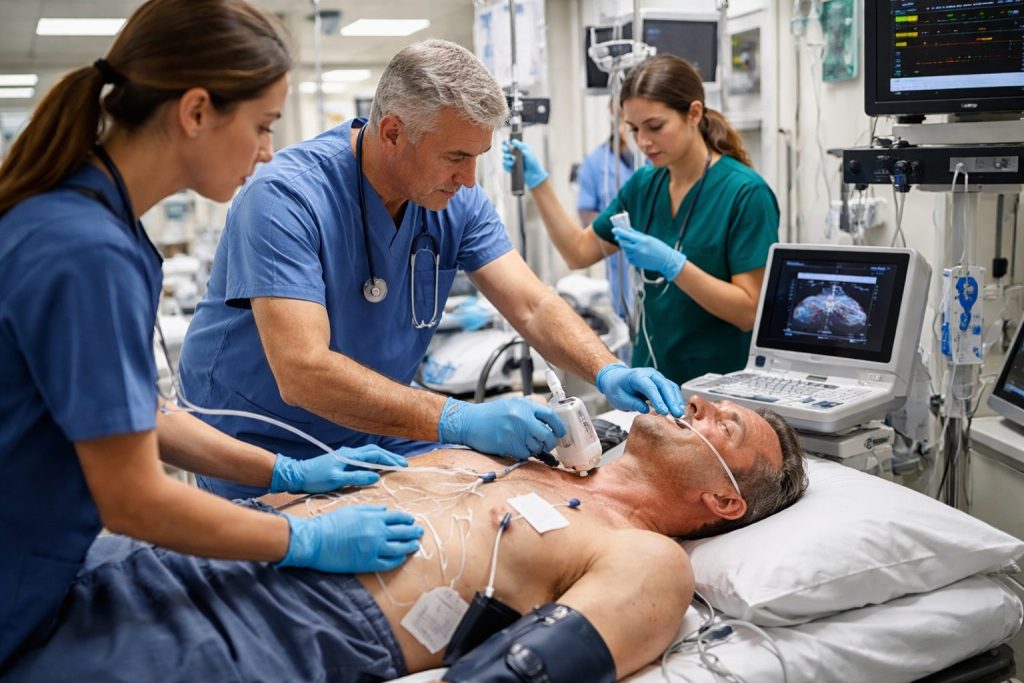
Pyrexia of unknown origin (PUO) sits at the intersection of almost every system the MRCEM SBA exam tests: infectious disease, haematological malignancy, autoimmune conditions, pharmacology and safe disposition decision-making. The classic Petersdorf and Beeson definition, requiring fever above 38.3 degrees C on multiple occasions persisting for more than three weeks without a diagnosis established after one week of inpatient investigation, was never designed for the acute ED encounter. What the ED registrar must master instead is a structured, risk-stratified approach that identifies immediately life-threatening causes, initiates appropriate investigation and makes defensible disposition decisions before a definitive label is ever attached. That competency is precisely what MRCEM SBA practice questions on this topic are designed to probe.
MRCEM SBA practice questions: Key Points: PUO in the ED for MRCEM SBA Candidates
- Malaria must be excluded in any febrile returning traveller using urgent thick and thin blood films, regardless of prophylaxis history.
- Sepsis recognition and the Sepsis-6 bundle take precedence over diagnostic precision when a patient is haemodynamically compromised.
- Infectious, neoplastic, non-infectious inflammatory and miscellaneous aetiologies each account for approximately 20 to 25 percent of PUO cases in resource-rich settings.
- Drug fever is a diagnosis of exclusion but should be actively considered in any patient on a new or recently changed medication with no other identifiable source.
- Adult-onset Still disease produces a characteristic quotidian fever spike with a salmon-pink rash and markedly elevated ferritin, a pattern frequently tested in SBA question stems.
- Safe discharge requires explicit safety-netting: written advice, clear return criteria and documented follow-up, in line with RCEM clinical standards.
Definition, Epidemiology and Why PUO Matters in the ED
The Petersdorf and Beeson definition remains the academic reference point but is operationally redundant in the acute setting. For ED purposes, PUO is better understood as a persistent or recurrent fever without an immediately apparent source after a focused ED assessment. This reframing matters because the ED registrar is not expected to reach a definitive diagnosis; they are expected to exclude life-threatening conditions, initiate an appropriate investigation pathway and ensure safe onward care.
The epidemiology of PUO has shifted considerably over recent decades. In resource-rich settings, infectious causes now account for approximately 20 to 25 percent of cases, down from the historical figure of around 40 percent as diagnostic imaging and microbiology have improved. Neoplastic causes, most commonly lymphoma (both Hodgkin and non-Hodgkin), leukaemia, renal cell carcinoma and hepatocellular carcinoma, account for a further 20 to 25 percent. Non-infectious inflammatory disease (NIID), encompassing autoimmune and autoinflammatory conditions such as adult-onset Still disease (AOSD), systemic lupus erythematosus (SLE), vasculitides and sarcoidosis, contributes a comparable proportion. Miscellaneous causes including drug fever, pulmonary embolism, haematoma resorption, hyperthyroidism and familial Mediterranean fever account for 10 to 15 percent. Crucially, in 15 to 25 percent of cases no diagnosis is ever established, and this group generally carries a favourable prognosis when fever resolves spontaneously. NICE guidance on fever management and BMJ clinical reviews on PUO both emphasise that the clinical priority is identifying the minority with sinister underlying pathology.
Pathophysiology: Fever as a Regulated Physiological Response
Fever is not a failure of thermoregulation but a regulated upward resetting of the hypothalamic set point, mediated by endogenous pyrogens. Exogenous stimuli, including microbial cell wall components (lipopolysaccharide, peptidoglycan), immune complexes and tumour antigens, activate macrophages and monocytes to release pro-inflammatory cytokines: interleukin-1 (IL-1), interleukin-6 (IL-6), tumour necrosis factor-alpha (TNF-alpha) and interferon-gamma. These act on the organum vasculosum of the lamina terminalis and the preoptic area of the anterior hypothalamus, stimulating cyclo-oxygenase-2 (COX-2) mediated synthesis of prostaglandin E2 (PGE2). PGE2 raises the thermoregulatory set point, triggering peripheral vasoconstriction and shivering to generate and conserve heat until core temperature matches the new set point.
This mechanism explains both why antipyretics (paracetamol, ibuprofen) reduce fever by inhibiting COX-2-mediated PGE2 synthesis, and why fever patterns have diagnostic significance. The quotidian spike pattern of AOSD (single daily temperature exceeding 39 degrees C, returning to normal or subnormal between spikes) reflects pulsatile cytokine release rather than continuous infection. Pel-Ebstein fever, the cyclical waxing and waning pattern historically associated with Hodgkin lymphoma, reflects periodic tumour-driven cytokine surges, though its diagnostic specificity is modest in clinical practice. Understanding these mechanisms at registrar level helps contextualise why the investigation strategy must span such a wide differential.
ED Assessment and Management
History: The Single Most Discriminating Tool
A structured history remains the highest-yield component of the initial assessment. Key elements include the precise duration and pattern of fever, any documented temperature recordings at home, associated symptoms (night sweats, weight loss, lymphadenopathy, rash, joint involvement, cough, urinary symptoms), drug history including over-the-counter medications, supplements and biologics, travel history with specific destinations and activities, occupational and animal exposure history, sexual history, immunisation status and family history of inflammatory or malignant conditions. The travel history demands particular attention: malaria must be excluded by urgent thick and thin blood films in any febrile patient returning from a malaria-endemic area, regardless of prophylaxis compliance, as parasitaemia can occur even with correctly taken chemoprophylaxis.
Examination: Red Flags and Specific Findings
A complete systemic examination is mandatory. Specific findings that substantially narrow the differential include lymphadenopathy (generalised suggests lymphoma, EBV or HIV; localised suggests regional infection or malignancy), splenomegaly (malaria, EBV, lymphoma, infective endocarditis), hepatomegaly (hepatocellular carcinoma, lymphoma, EBV, CMV, granulomatous disease), new or changing cardiac murmur (infective endocarditis, atrial myxoma), salmon-pink evanescent rash (AOSD), oral ulcers or malar rash (SLE), temporal artery tenderness (giant cell arteritis in patients over 50), and skin findings such as Osler nodes, Janeway lesions or splinter haemorrhages (infective endocarditis). The presence of haemodynamic compromise, altered consciousness, petechial or purpuric rash, or signs of end-organ dysfunction mandates immediate sepsis management under NICE NG51 (Sepsis) before any further diagnostic workup proceeds.
Investigations: First-Line ED Panel
The initial investigation panel should be targeted to identify immediately life-threatening diagnoses and to generate a specimen archive for subsequent specialist review. A reasonable first-line panel includes full blood count with differential (eosinophilia suggests parasitic infection or drug reaction; atypical lymphocytes suggest EBV or CMV; blasts suggest leukaemia), C-reactive protein and erythrocyte sedimentation rate, urea and electrolytes, liver function tests, lactate dehydrogenase (LDH, elevated in lymphoma and haemolysis), blood cultures (a minimum of two sets from different sites before antibiotics where the clinical situation permits), urine dipstick and microscopy/culture, chest X-ray, and thick and thin blood films in any traveller returning from an endemic region. Ferritin is a high-yield addition: a markedly elevated ferritin (greater than 10,000 micrograms per litre) in the context of quotidian fever, arthritis and rash should prompt consideration of AOSD, macrophage activation syndrome or haemophagocytic lymphohistiocytosis (HLH), all of which carry significant morbidity without prompt treatment. HIV serology should be offered routinely given its broad differential contribution.
Management Algorithm: Treat the Patient, Not the Label
When the patient is haemodynamically compromised or demonstrates red-flag features, the Sepsis-6 bundle as promoted by the Resuscitation Council UK and the UK Sepsis Trust must be initiated within one hour: high-flow oxygen, IV access with blood cultures, IV broad-spectrum antibiotics, IV fluid resuscitation (500 mL crystalloid bolus, reassessing after each), urine output monitoring via catheterisation, and serial lactate measurement. Empirical antibiotics should cover the most likely and most dangerous organisms given the clinical context, following local antimicrobial stewardship guidelines. Where the patient is systemically well with no red-flag features, empirical antibiotics are generally not indicated before a source is identified, as they may mask the diagnosis and compromise subsequent microbiological investigation.
Antipyretics should be used for patient comfort rather than as a diagnostic manoeuvre: the historical practice of withholding antipyretics to observe fever patterns has limited diagnostic utility and causes unnecessary suffering.
How the MRCEM SBA Exam Tests PUO
PUO is a topic that lends itself particularly well to the SBA format because it demands integration of multiple knowledge domains within a single clinical vignette. MRCEM SBA practice questions on this topic typically use one of three stem structures. The first presents a returning traveller with fever, and the correct answer requires identification of malaria as the priority exclusion and urgent blood film as the correct investigation, distinguishing it from distractors such as empirical antibiotics or immediate CT imaging. The second presents a patient with weeks of night sweats, weight loss and cervical lymphadenopathy, where the correct answer involves identifying lymphoma as the most likely diagnosis and ordering LDH and urgent haematology review rather than broad-spectrum antibiotics. The third, and most discriminating, presents a young adult with quotidian fever, arthritis and an evanescent rash with a serum ferritin of 15,000 micrograms per litre, requiring recognition of AOSD and appropriate specialist referral.
Curriculum mapping places PUO within the RCEM curriculum domain of acute medicine and undifferentiated illness. Candidates should note that the exam tests recognition of the condition and appropriate initial management, not subspecialty management of the underlying diagnosis. Common pitfalls include selecting empirical antibiotics as the first step in a haemodynamically stable patient without a clear infectious source, failing to request blood films in a returning traveller, and misidentifying drug fever as infectious fever without considering the medication history.
Thorough preparation using a structured MRCEM Single Best Answer revision course at EM Learning Centre that includes clinical scenario-based questions is the most effective way to build both the knowledge base and the exam technique required for this topic.
Revision Pearls: High-Yield Facts for MRCEM SBA
- Malaria is a medical emergency: thick and thin blood films must be requested urgently in any febrile returning traveller regardless of prophylaxis history. Three negative films over 72 hours are required to exclude malaria reliably.
- Infective endocarditis can present insidiously with weeks of low-grade fever and non-specific malaise; always auscultate for new murmurs and request echocardiography if clinical suspicion exists.
- AOSD diagnosis rests on the Yamaguchi criteria and is suggested by the triad of quotidian fever, arthritis and evanescent salmon-pink rash with markedly elevated ferritin.
- Drug fever typically presents 7 to 10 days after starting a new drug, may be accompanied by eosinophilia and relative bradycardia, and resolves within 72 hours of drug discontinuation.
- LDH elevation in a febrile patient with constitutional symptoms and lymphadenopathy should prompt urgent consideration of lymphoma.
- Giant cell arteritis must be considered in any patient over 50 with unexplained fever, elevated ESR and new headache or jaw claudication; early corticosteroid treatment is sight-saving.
- HLH and macrophage activation syndrome carry high mortality if missed; the combination of very high ferritin, cytopenias, splenomegaly and coagulopathy in a febrile patient demands urgent haematology review.
- A normal or undiagnosed PUO in a systemically well patient without red flags carries a generally favourable prognosis, but requires structured follow-up and clear safety-netting documentation.
Common Pitfalls: Where Candidates Lose Marks
- Giving empirical broad-spectrum antibiotics to a stable, well-appearing febrile patient before blood cultures are taken, thereby compromising microbiological yield.
- Failing to include travel history systematically, missing the malaria diagnosis.
- Selecting CT chest-abdomen-pelvis as the first-line investigation in a febrile patient rather than completing basic blood and microbiological tests first.
- Overlooking the drug chart entirely in a hospitalised or recently medicated patient, missing drug fever as a diagnosis.
- Applying the classic Petersdorf and Beeson three-week criterion as a prerequisite before initiating investigation in the ED, thereby delaying workup inappropriately.
- Discharging a febrile returning traveller without blood films because malaria prophylaxis was reportedly taken.
How EM Learning Centre Supports Your MRCEM Single Best Answer Revision
PUO is one of the topics where candidates most commonly underestimate the breadth of knowledge the MRCEM SBA exam demands. It is not sufficient to know the differential in the abstract; you must be able to select the single best investigation, the single best management step and the single best disposition decision within the constrained context of an SBA question stem. The EM Learning Centre MRCEM Single Best Answer course addresses this directly through structured lessons on acute undifferentiated illness, targeted question banks with detailed explanations, and clinical scenario walkthroughs mapped to the current RCEM curriculum. Whether you are approaching your first attempt or refining your performance ahead of a resit, working through MRCEM SBA practice questions with high-quality rationales is the most efficient route to consolidating this kind of integrative clinical reasoning. Explore the full range of resources available through the MRCEM Single Best Answer revision course at EM Learning Centre and build the systematic approach that the exam, and your patients, require.
References
- National Institute for Health and Care Excellence. Sepsis: recognition, diagnosis and early management (NG51). 2016, updated 2024. NICE (nice.org.uk)
- BMJ. Clinical reviews on pyrexia of unknown origin. The BMJ (bmj.com)
- Resuscitation Council UK. Advanced Life Support and Sepsis Guidance. Resuscitation Council UK (resus.org.uk)
- Royal College of Emergency Medicine. RCEM Curriculum and Clinical Standards. RCEM (rcem.ac.uk)
- NICE Clinical Knowledge Summaries. Fever management in adults. NICE Clinical Knowledge Summaries (cks.nice.org.uk)